'Oeko,' or 'house' is the Greek root of the word 'ecology.' Here are my thoughts as I search for home.

Saturday, May 14, 2011

Life goes on

I started journaling for the first time when I was eight years old. At that point, most of my entries consisted of descriptions of what Mom made for dinner. And many of my entries started like this:
"Sorry it's been awhile since I wrote . . ."
I don't know who I was apologizing to, since my journal was private, but I feel the same way now. Life has been hectic lately, and I haven't had the focus to sit down and write about it. I haven't known where to begin. Since my last post wandered all the way to el Caribe, let's start back at home with a pumpkin house check-in.

The chickabiddies are growing girls, and a few weeks ago Chris and I moved them out to the coop with the old hens. It was easier than we'd thought it would be to make a chicken-wire barrier that lets them get used to each other without letting the big ones peck the little ones to death. This may be unnecessary since there's been no threatening behavior since the first few days, and no signs of violence when we do supervised visitations; but better safe than sorry.


The hens were pecking and eating their eggs for awhile, and it got to the point where I was making death threats ("If you don't stop eating you're eggs, we're going to eat you!) until I stuck an easter egg in their nest. Since then there have been no more broken shells. I guess the theory is that they try to peck on the plastic eggshell, and since it kind of hurts their beak it helps break the habit.

Spring has sprung. With it come nettle pesto, fiddlehead ferns, and lots of weedy wild greens. I tried lacto-fermenting some fiddlehead ferns with carrots, and then forgot about them in the back of the cupboard for almost a month. This photo was taken when I first put them in the jar with some whey, water and pickling spices. Now the water is a light yellow color, and fizzed up like crazy when I opened the jar. I tasted a fiddlehead, and it was very pickle-y, fizzy and a bit peppery. I think I like it, but I haven't decided yet, and I'm going to wait a while and make sure it doesn't make me sick before offering it to anyone else.

I've been doing some flower gardening in northwest Portland, which is great fun; I dig getting paid to play in the dirt, and it's novel and refreshing to work in a garden whose sole purpose is beauty.
Meanwhile, the garden at home is plugging along -- the alliums are happy, the kale is getting a bit slug-eaten, and the tomatoes have yet to journey beyond their kitchen table window home.
Also the camas is blooming, which means it is time to harvest it. What is camas, you ask? Well, it looks like an onion, tastes like a cross between potato and baked pear, and once upon a time it blanketed the prairies of the Pacific Northwest with a sea of starry blue flowers. Traditionally harvested from what is now Vancouver Island to northern California, blue camas was among the most important plant foods in the region. It cohabitated unique ecosystems with Garry oak, bear grass, a multitude of butterflies, deer, and, importantly, indigenous peoples. Today, only about three percent of the original camas prairies still remain (The Nature Conservancy).
That was the opening paragraph to a final essay I wrote about it for an environmental policy class a few years ago. I became slightly obsessed with learning about camas when I realized it was an incredibly important native plant food that had never even been on my radar before.
Anyway, I got some bulbs last fall and now it's blooming in our raised beds.
The only catch is that I tried some prepared the traditional way, steamed in a pit fire, and I wasn't a big fan of the flavor. So I have some serious research and experimentation ahead of me if I want to enjoy the taste of camas.

Some pizza Chris made awhile ago, served with
miner's lettuce and kefir cheese salad. I miss him and his pizza.


So that's the news from the pumpkin house farm, where all the women are sleepy, all the cats are needy, and all the men are up in the Seattle suburbs house-sitting for their parents.
(I'll save the part about why life has been so hectic lately for the next post, by which time maybe the chaos will have settled down a bit.)

Monday, April 18, 2011

La Isla

My thoughts lately have been drifting away from our pumpkin house farm, and toward the Dominican Republic. Even as I continue in my kefiry, sourdoughy endeavors, and even as the sun breaks through the clouds to welcome a tentative spring, I'm daydreaming of where I hope to be next winter.

This is still related to the theme of finding home, and here's why: I have a second home, one that I haven't visited in several years, but a second home nonetheless.

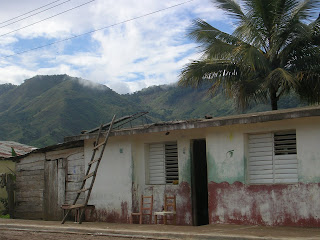
The last time I visited Rio Limpio was the Christmas before last. I was welcomed back into the family that had first hosted me when I was sixteen and speechless, delivered by an international volunteer program to their doorstep. Reunited, we caught up on what had been going on in each others' lives since my last visit. My host brother had married, had a child, divorced and most recently been almost killed in a truck accident. My host sister, who is studying to be a doctor, was nursing him back to health while continuing to be active in her church. She was also phone-dating an Ecuadorian man who lived in the United States; they were star-crossed lovers, since as an undocumented immigrant he could not leave the US, and my host sister had little desire to go there, and no means of getting a visa anyway. Apart from worrying about her son's injury and her own evolving health problems, my host mother was the only one whose life remained mainly the same. She maintained her complaints about her husband's debt, absence and infidelity, while he maintained his distance and ignored his wife as much as possible.
Funny how when you don't see people for a while, their lives become distilled into a two-dimensional gossip column. But it was so good to see these people, and to have our lives intersect again.
The other news I got caught up on was the news of the town, Rio Limpio. Where there used to be only sporadic electricity, now the government had installed solar panels on all the roofs. Now you could do laundry whenever you wanted . . . while your husband and his friends watched American television. There was also increasing talk of paving the hazardously muddy road into town. There has always been such talk, but with the rate of change in Rio Limpio, now I was starting to believe it.
A paved road would make life better in many ways. It would buy critical hours of travel time, allowing sick and injured people to reach city health care facilities. It would make it easier to visit family in the city, and vice versa. It would indirectly bring all kinds of employment opportunities to a depressed little mountain town.
But people in Rio Limpio complain about the traffic and crime problems in the city, and they lament the loss of time to enjoy life. That's what keeps them in Rio Limpio despite the poverty and struggles of hard manual labor: the chance to sit and talk over coffee with family and friends, to walk across town to call on a sick neighbor or a grieving relative, or to play dominoes in the backyard amidst clucking hens and the blaring of bachata music on a distant radio station.
I'm in no place to judge development in Rio Limpio; I may call it home but I don't live there. I can only look on in wonder as these changes come to pass. Still, I was heartened to find that CREAR, the local school for organic agriculture, had regained its funding and was thriving more than ever. I was also excited to speak with the father-in-law of my host brother, who was working with the eco-tourism office in Rio Limpio, and who was thinking critically about sustainable development and was actively working to guide the town's progress in a way that would be healthy for everyone.
Most of all I was excited to visit a biodynamic farm that I had heard about previously but never actually been to. On the edge of a national park, the farm blended into the forest except that it was brimming with food -- grapefruit, oranges, cacao, coffee, and ginger were all intermixed in what seemed to be a kind of Eden, a magic food forest. At the time, I daydreamed about going back for a longer period of time to do some kind of internship at the farm and nursery, helping with translation if it were needed, and learning about sustainable agriculture in the tropics. Now as I write about it, I'm getting excited about that idea again. I googled it and found that Rio Limpio now has a slick tourism website. It's bizarre to see the people and places I know, who have always seemed a world away, within such an easy reach through cyberspace.
But what does this mean for my oekoseeking here? How can I board a plane and ditch all the things I've been working on? Would they still be here when I got back?
Most of all, do I lose integrity by spreading myself across so much space? Feeling proud as I ride my bike to work, but happily boarding a plane to burn fossil fuels for 3,000+ miles and then talk about "sustainability?"

Thursday, April 7, 2011

Chicks' first day in the sun

The other day I brought the chickabiddies outside for the first time.

Let me first just say that I don't consider myself to be a sentimental chicken owner. Chickens are fascinating creatures in their funny way, and I respect their expert scratching in the dirt for food, their crazy dinosaur noises and their cruel but straightforward pecking orders. Most of all I respect them for their ability to convert seeds, worms and grubs ('Gross!' says Chris) into delicious eggs and eventually meat. But I don't think they love me, and I don't love them -- at least not in the same way I would love a cat or dog. I feel responsible for protecting them and caring for them, but it's not like they're cuddly.

That said, it was something to see them blink in the sun for the first time. Inside their cardboard box, they look huge. But outside they were barely taller than the grass, and they stayed right next to me for the first five minutes, peering up at me as though I might offer some guidance. So without thinking about it I started roughing up the dirt with a stick, and eventually they followed suit, scratching and pecking.

I had planned on patching my bike tire while they were exploring the wide world, but they were much too distracting and the whole process took me ages. It was just too entertaining to watch them pick their way through the grass. They weren't very good at it yet; they mostly ate dirt.
Not to mention the fuss Swinkles and Turnip were making. Enclosed in their coop, they ruffled their feathers and made so many weird barking noises that I was worried the neighbors would complain. I think they would have eaten Penguin and Dundee alive if we'd let them. It will be no easy chore to create a harmonious flock out of these warring dinos.
After about half an hour I brought the chicks back inside though; it was enough excitement for a day. The next step will be making a safe enclosure to use in transitioning them outside.

Saturday, April 2, 2011

More kefir cheese madness


I've been having so much fun with kefir that I decided to do some more research about it. I won't re-write all I learned; a simple google search will tell you more than you ever wanted about kefir. But to summarize: kefir is a cultured milk beverage that, like yogurt, originated in the Caucasus Mountains, between the Black Sea and the Caspian Sea, crossing the borders of Russia, Georgia, Armenia and Azerbiajan. According to the computerized cosmos, kefir has 5 times the beneficial microflora that yoghurt does and has helped treat everything from indigestion to tuberculosis. It also has lots of good vitamins, minerals and enzymes. I like it because it's delicious and easy to make.
We drink kefir every morning with breakfast, and in the past I've strained it into a thicker, more yogurty cream for serving with rice and beans. But now I'm going crazy with kefir cheese.

Here is some kefir hanging in a towel so that the whey is strained out of it. Last time I didn't hang it, I just set it in a towel in a strainer, and it worked all right but the kefir cheese was a bit wet. I think gravity will be more on my side this way, for a drier cheese that stays in ball-form instead of disintegrating in the jar of olive oil.
It seemed to work pretty well: here are the kefir balls preserved in olive oil. The only issue now is that the kefir floats to the top, instead of staying submerged in olive oil. So I have to swish it around occasionally to make sure the cheese stays oil-coated and unexposed to air.

I also didn't have enough olive oil to cover all the kefir, so I tried a makeshift cheese press to see how the rest of the kefir would work as a hard cheese. It came out looking and feeling a bit like queso fresco, so at first I hoped it would work well with our usual rice and bean staples.
Which would be wonderful, since cheese is currently our chief food budgeting woe -- there seems to be no affordable way to get enough organic cheese for our pizza and taco needs. (We settle for Tillamook cheese because although it's not organic, at least it is labelled 'no-rBGH.')
But on second thought, after eating more than a small taste I realized I don't really like the taste of the dry kefir cheese. So I dipped it in beeswax to preserve it and see if it mellows with age. Dipping it in beeswax turned out to be a really fun process, so I hope the cheese ends up tasting good.
This cheese-aging thing was slotted to be my next experiment anyway, because I saw it on a website with many other kefir cheese variations. Dom's (very eccentric!) kefir website is an awesome resource. If you want to be overwhelmed with kefir possibilities, this is the place to go! http://users.sa.chariot.net.au/~dna/kefirpage.html

Kefir cheese after being pressed.


Kefir cheese dipped in beeswax.

I like making kefir cheese because there's no fussing with heating milk, using the dairy thermometer, or praying that the rennet will do its magic curdling. Also, I find my stomach does better with dairy when I'm drinking kefir. I do want to make real cheese one of these days, but for now this is where I get my kicks.


Wednesday, March 30, 2011

New Old Hens


The "free" section on craigslist gives rise to all kinds of craziness.

Yesterday I saw an ad offering two 3-year-old hens, still laying, along with their coop. Thinking how our little chickabiddies won't be laying for a while yet, I figured it would be nice to have eggs this week. And although they probably won't keep laying for long, these new old hens look healthy and happy for now. Later on maybe they will make a nice stew. Besides, having full grown hens will spur us on in our efforts to create an outside chicken habitat. (Penguin and Dundee are still box-dwelling birds, pooing on old socks for bedding and basking in the light of my mother's hand-me-down heat lamp.)

So early this morning Chris and I tossed a couple of hens in the trunk of the car to wait for us as we dismantled their chicken coop. We made a little tarp tent to keep them from getting into the back seat and turning the car into a latrine. It was effective at keeping the car clean but also fogged up the windows. I think the chickens could breath all right through the gaps, and hopefully they enjoyed their chicken sauna.
After removing a few dozen rusty screws from the rotting wood of the chicken coop, we had the roof separated from the sides. We bundled it on top of the car and rolled back home. My grandmother would be livid if she saw the things we put her car through. Sorry Boo, we know you wouldn't approve. But we are very, very grateful!
Once we had unloaded everything else into the backyard, we gave the chickens free range to explore their new digs. And dig they did. It must be nice to never doubt your purpose in life; if you are a chicken, it's all about scratching about in the dirt for grub.

The coop went up more easily than we had feared. Chris still complained that I have turned him into my farmhand, but at least we finished before I had to leave for work. And I don't think he was really too put off by it. After all, he got to name them: Swinkles and Turnip.

New old hens in their new old house.

A couple of years ago, I would never have thought we could do this, all in a days' work. Not that there isn't a long way to go, of course. There are a couple of gaps in the chicken wire that I want to fix, and we'll have to figure out a new housing situation once Penguin and Dundee move outside. And there is always the to-do list, all my mantenimiento that cries out to be dealt with. But it gives me hope to think that just by saying, "yes, let's do it!" we can be on our way to where we want to be. It just takes that spirit of possibility to take off running with a project and end the day feeling satisfied.

Sunday, March 27, 2011

Forest Salad and Kefir Cheese


Yesterday my partner Chris and I drove to a farm outside Sandy, OR to pick up some raw milk for ourselves and a group of friends. I felt I was being initiated into some kind of secret club; people who drive out to farms to buy milk seem to be in their own category of sustainable foodie extremeness. A club open only to the radical, privileged elite who can and will spend an afternoon trucking out to the country on their quest for real food. I guess I'm not sure how I feel about that. It makes the carbon footprint of a gallon of milk all too tangible, and puts me one step closer to being part of a character sketch on the show "Portlandia."

We took the trip as an excuse for go for a hike on Sandy Ridge, up a winding trail more geared for mountain bikers than for the likes of us. It was spring in the woods. The sun was showing through occasional showers of rain, the new leaves of the Indian plums were a brilliant green, and we were dawdling along our way, nervously peering up the trail so as not to be run over by Mt. Hood's two-wheeled thrill seekers. I gathered some miners' lettuce and oxalis. Picking baby greens is a tedious task any way you cut it -- they're so tiny, it takes ages to pick enough for a salad. But it's all worth it when you sit down to dinner for the first fresh greens of the season. (After excessive photography for bragging purposes, of course.)

The rest of our dinner was a bread and hummus extravaganza inspired by some kefir cheese that I had preserved in salt and olive oil last week. The whole process needs some tweaking; I didn't realize that the kefir cheese would continue to ferment and expand, dripping olive oil all over our cabinets and giving the cheese a bit of carbonation. Next time I'll leave more room at the top of the jar! The cheese came out well though, despite the mess. Kefir is amazing. Life is delicious. Food is heavenly.

Dinner pallet: Homemade sage-sea-salt-sourdough bread, cucumbers, tomatoes, pickled onions, and salted kefir cheese in olive oil. Just don't tell anyone we got the veggies and hummus from Safeway . . .

Mantenimiento


It's hard to focus on writing when I'm at home - ironic since I'm supposed to be writing about home - but my thoughts are scattered by a to-do list that will probably never end: unpack, do laundry, clean the chick's bedding, clean the kitchen, make bread, fix my banjo neck, practice the banjo, plant snow peas, water the seedlings in the greenhouse, pick more nettles, fix my sewing machine, mend a scratched-up armchair . . .

But then again, this is what home feels like these days: an endless procession of tasks. When I'm feeling defeated by what feels like a daily grind, I often think of a book I read a couple of years ago called Zapotec Science. It's a book about subsistence agriculture in indigenous communities, where people use the term mantenimiento (maintenance) to describe the daily tasks and rituals involved in sustaining their way of life on the land. I don't know why that word resonates so much with me, but I think of it often.

For me it has come to mean that there is value in the daily rhythms and routines, in just keeping on keeping on. In a society obsessed with forward motion, mantenimiento is a reminder that the most profoundly powerful forces are not linear but cyclical. Spring blooms into summer, explodes in fall, decomposes in winter, only to be born again. Rain turns to oceans that fly into the sky and become clouds, only to fall again. I cook to clean to cook to clean to cook.